You can access my all of papers at 🔗Google Scholar.
2026
PGPO: Prototype-Guided Progressive Obfuscation for Privacy-Preserving LLM-Enhanced Recommendation
Shengxiang Lin, Jiajie Su, Pengyang Zhou, Xiang Chen, Xiaolin Zheng, Feng Tian, Chaochao Chen
The 2026 Conference on Empirical Methods in Natural Language Processing
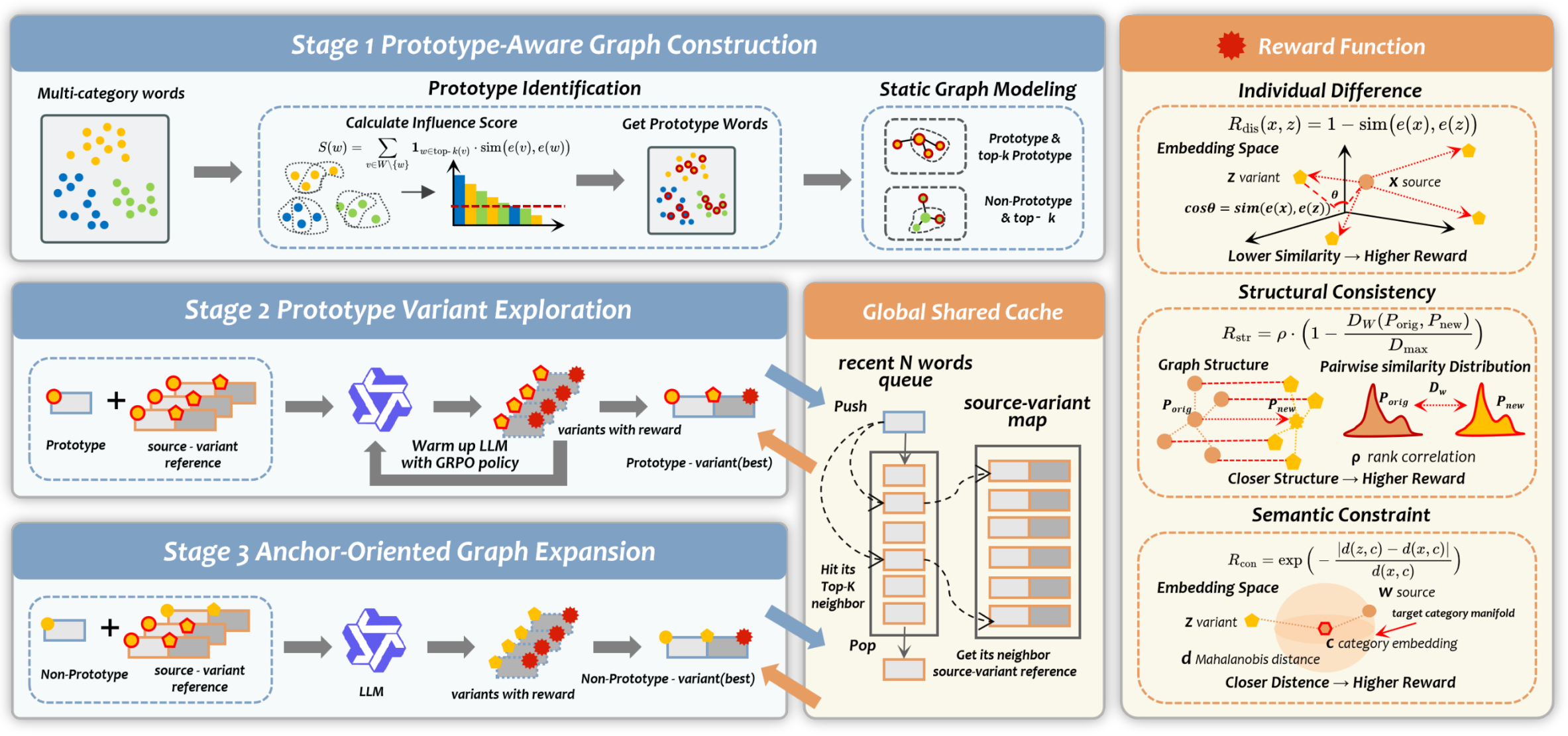
LLM-enhanced recommender systems encode item side information into semantic embeddings, but these embeddings may leak sensitive textual attributes through inversion attacks. Existing input-side defenses rely on trusted collection or local token perturbation, often disrupting the inter-item semantic topology needed for recommendation. To address it, we introduce relational fidelity as the key objective, requiring semantic shift for privacy while preserving relative item relations for utility. Based on this principle, we propose prototype-guided progressive obfuscation (PGPO), which learns topology-aware obfuscation anchors for high-influence prototype words and propagates them through a static semantic graph. PGPO is optimized with GRPO using individual dissimilarity, structural consistency, and semantic constraint rewards. Experiments on two benchmarks show strong inversion defense with near-upper-bound recommendation performance.
2025
Lightweight Deep Learning Framework for Accurate Particle Flow Energy Reconstruction
Yu Wang, Yangguang Zhang, Shengxiang Lin, Xingyi Zhang, Han Zhang
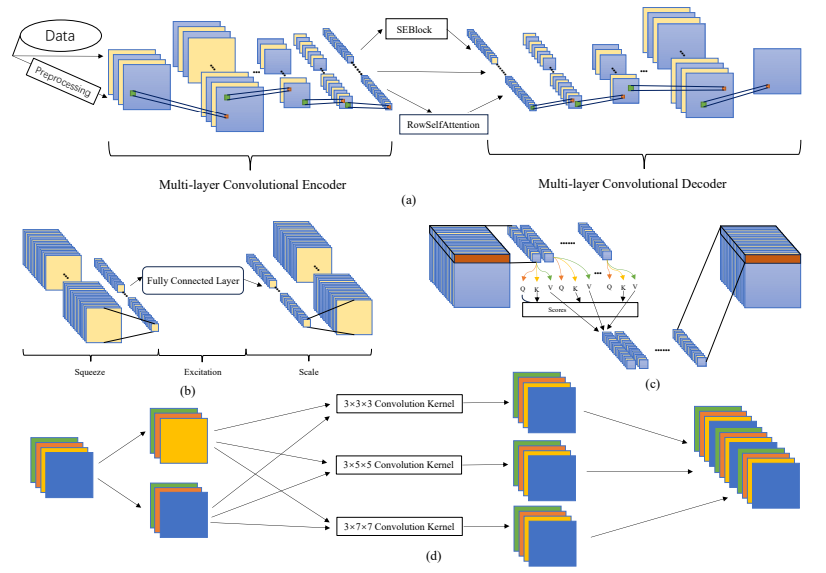
Under extreme operating conditions, characterized by high particle multiplicity and heavily overlapping shower energy deposits, classical particle flow algorithms encounter pronounced limitations in resolution, efficiency, and accuracy. To address this challenge, this paper proposes and systematically evaluates a deep learning reconstruction framework: For multichannel sparse features, we design a hybrid loss function combining weighted mean squared error with structural similarity index, effectively balancing pixel-level accuracy and structural fidelity. By integrating 3D convolutions, Squeeze-and-Excitation channel attention, and Offset self-attention modules into baseline convolutional neural networks, we enhance the model's capability to capture cross-modal spatiotemporal correlations and energy-displacement nonlinearities. Validated on custom-constructed simulation data and Pythia jet datasets, the framework's 90K-parameter lightweight variant approaches the performance of 5M-parameter baselines, while the 25M-parameter 3D model achieves state-of-the-art results in both interpolation and extrapolation tasks. Comprehensive experiments quantitatively evaluate component contributions and provide performance-parameter trade-off guidelines.