I(X; Z | O)
Trajectory uncertainty
An attacker observes the released variant but not the realized cache/history trajectory, so recovery must marginalize hidden generation paths.
Protecting textual privacy in LLM-enhanced recommendation while preserving the relational structure that downstream recommenders rely on.
1 Zhejiang University · 2 Xi'an Jiaotong University · * Corresponding authors
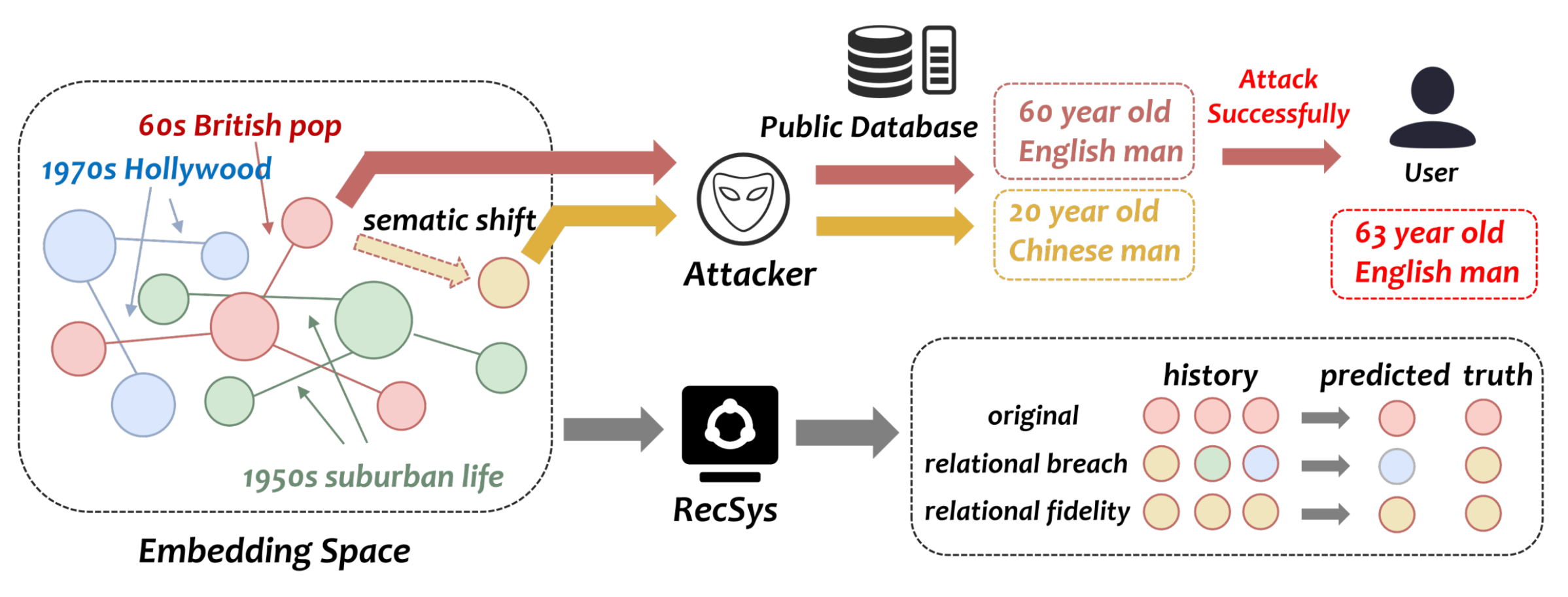
LLM-enhanced recommenders can benefit from textual side information, but the resulting semantic representations may expose sensitive item attributes to inversion attacks. PGPO shifts the goal from preserving literal semantics to preserving relational fidelity: change what individual words reveal while retaining how items relate to one another.
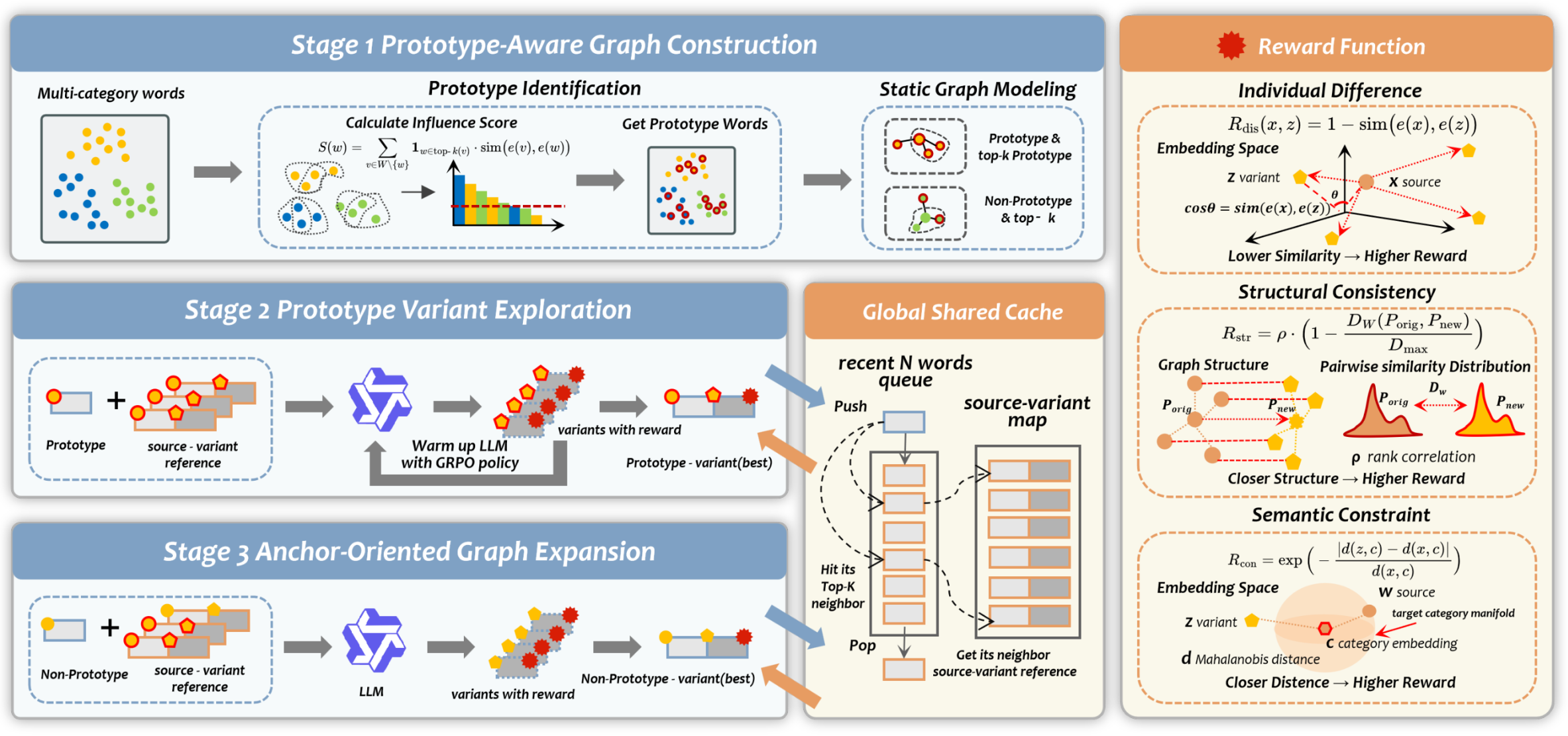
The method combines a prototype-aware semantic graph, GRPO-based anchor exploration, and graph-guided progressive expansion. The released repository covers the whole pipeline from side-information construction and training to recommendation evaluation and two complementary privacy attacks.
LLM-enhanced recommender systems encode item side information into semantic embeddings, but these embeddings may leak sensitive textual attributes through inversion attacks. Existing input-side defenses rely on trusted collection or local token perturbation, often disrupting the inter-item semantic topology needed for recommendation. We introduce relational fidelity as the key objective: semantic shift should be large enough for privacy while relative item relations remain stable for utility. PGPO learns topology-aware obfuscation anchors for high-influence prototype words and propagates them through a static semantic graph. It is optimized with GRPO using individual dissimilarity, structural consistency, and semantic constraint rewards.
Protecting an item independently is not enough. Recommendation quality depends on relative structure in semantic space. A useful privacy transformation therefore needs to move exposed content away from the original while keeping the neighborhood geometry useful to the recommender.
PGPO builds a static vocabulary-level semantic graph and selects high-influence prototype words that form a compact structural backbone.
For prototypes, the policy explores variants under three complementary rewards: individual dissimilarity, structural consistency, and semantic constraint.
Finalized prototype mappings are cached and reused as contextual anchors while the model expands from the semantic core to non-prototype words.
The paper also analyzes why path-dependent generation can make source recovery harder. The formal guarantees rely on the assumptions stated in the paper; this section summarizes the intuition rather than replacing the full derivation.
I(X; Z | O)
An attacker observes the released variant but not the realized cache/history trajectory, so recovery must marginalize hidden generation paths.
H(α)
Reward shaping encourages multiple plausible semantic modes instead of a single deterministic transformation path.
Psucc
Under the paper's finite-vocabulary assumptions, higher output and trajectory uncertainty contribute to a lower upper bound on inversion success.
For final item representations, the paper further uses a data-processing argument: when collaborative signals contain limited residual information about the source text, reducing text-level leakage also reduces representation-level leakage.
Vec2Text is trained on disjoint data and evaluated under aligned original–obfuscated cosine similarity for a fair comparison across perturbation methods.
The attacker knows the optimized conversion model, vocabulary, semantic graph, retrieval function, and prompt, but not the cached history or realized generation trajectory. Each test uses the true source plus 50 negatives.
Recommendation backends: SASRec, LightGCN, FREEDOM, LightGT, TALLRec, and LLaRA. Baselines: InferDPT, Text2Text, SanText+, and TextObfuscator (TOF).
PGPO produces valid variants for nearly all words while achieving the highest local-topology Spearman correlation among the compared methods on both datasets.
| Dataset | CosSim | KL | NLL | D-2 | D-1 | LR |
|---|---|---|---|---|---|---|
| MovieLens-1M | .6293 | 7.9264 | 5.7050 | .4257 | .1960 | .8758 |
| Amazon-Book | .6519 | 6.9642 | 10.0452 | .3378 | .1661 | .9628 |
Across sequential, graph-based, multimodal, and LLM-based recommenders, PGPO remains close to the unprotected-description upper bound. The table highlights representative metrics from the latest manuscript.
| Dataset | Input | SASRec HR@10 |
LightGCN HR@10 |
FREEDOM HR@10 |
LightGT HR@10 |
TALLRec AUC |
LLaRA HR@1 |
|---|---|---|---|---|---|---|---|
| MovieLens-1M | Description | .1129 | .0850 | .0840 | .0847 | .6990 | .2454 |
| PGPO | .1133 | .0848 | .0842 | .0839 | .6978 | .2451 | |
| Amazon-Book | Description | .1843 | .0926 | .0762 | .0929 | .7983 | .5348 |
| PGPO | .1846 | .0920 | .0753 | .0930 | .7979 | .5257 |
The aligned-CosSim inversion evaluation shows that PGPO provides substantial protection without the recommendation degradation seen in token-level perturbation baselines. A stronger white-box Replay-MLE attacker is used in the ablation analysis below.
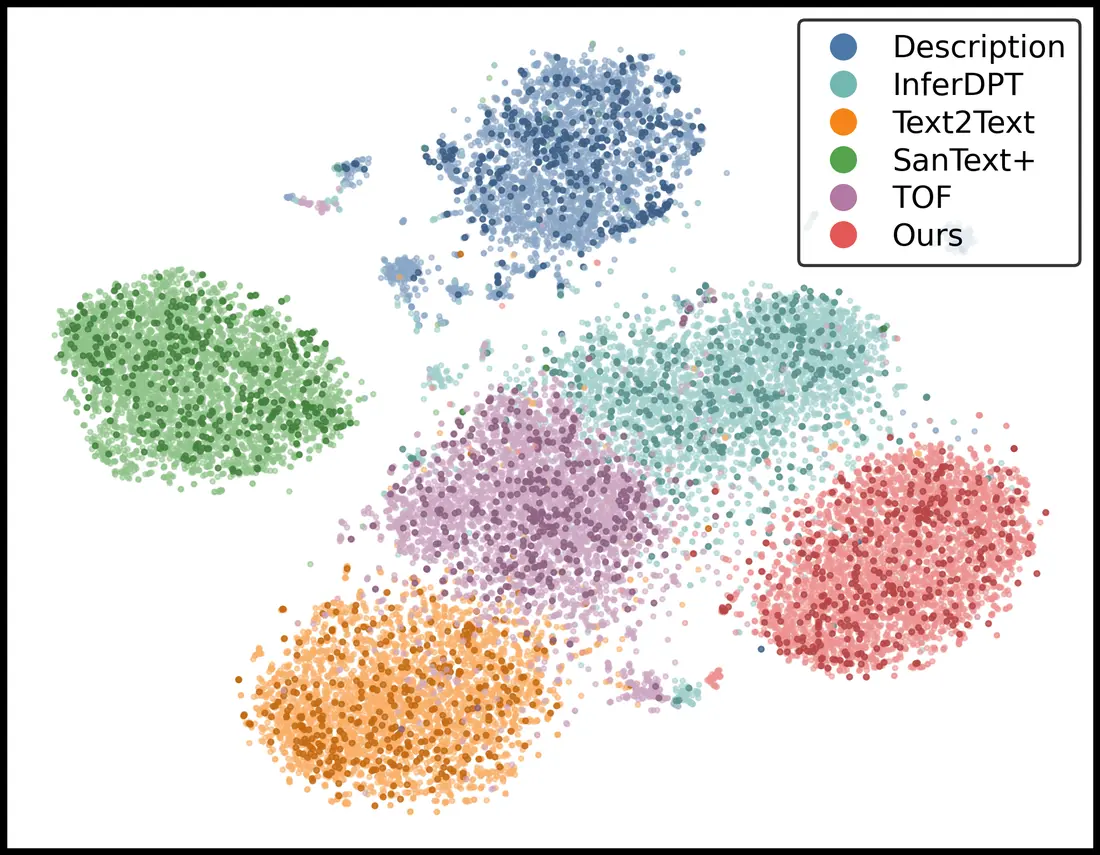
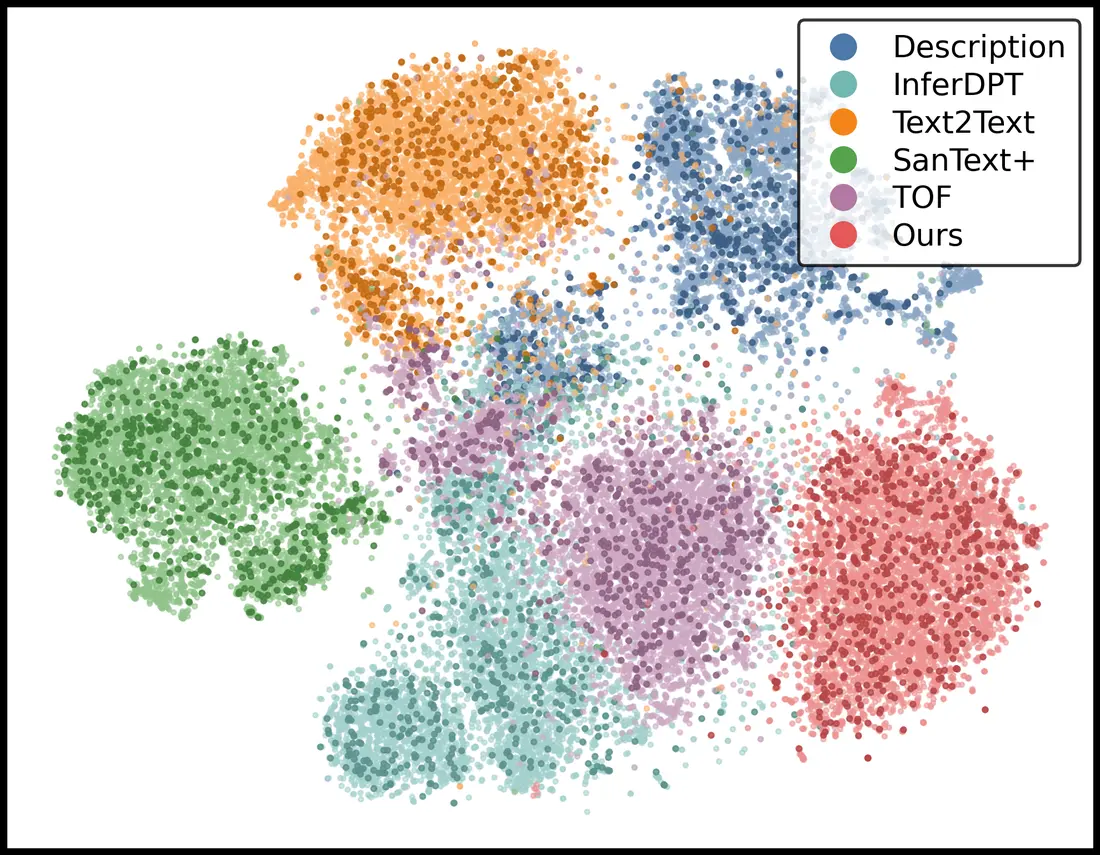
The two datasets are shown together for direct comparison rather than using one oversized row per figure.
| Method | ReID@1 ↓ | MRR ↓ | Hatt ↑ | Iatt ↓ |
|---|---|---|---|---|
| w/o GRPO | .5946 | .6796 | 1.129 | 4.515 |
| w/o context | .4406 | .5627 | 1.506 | 4.138 |
| w/o dissimilarity | .8918 | .9210 | .268 | 5.376 |
| w/o structural | .1959 | .3102 | 1.790 | 3.854 |
| w/o constraint | .3435 | .4441 | 1.455 | 4.189 |
| PGPO | .2642 | .3795 | 1.647 | 3.997 |
Several analyses that are easy to miss in the paper's main body are useful for understanding how PGPO behaves in practice.
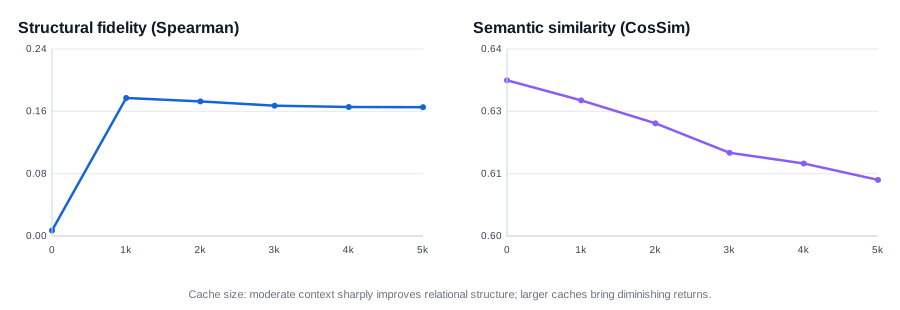
Removing the cache nearly destroys local structural preservation (Spearman 0.0070). A moderate cache restores relational anchors; very large caches bring diminishing returns and increasingly favor low-similarity variants.
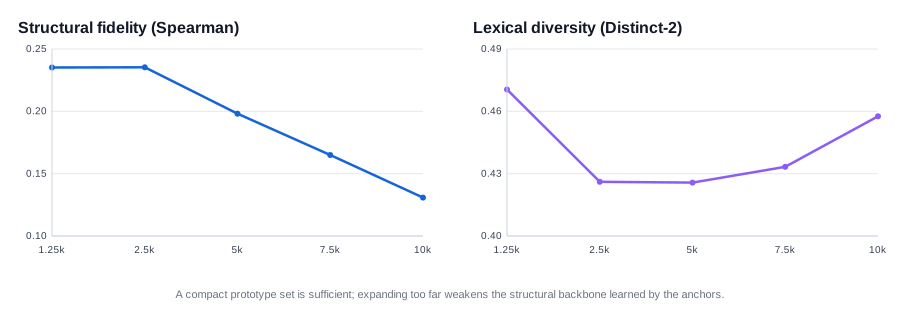
A small high-influence set is already enough to establish effective anchors. Expanding too far makes structural learning harder: Spearman falls from about 0.235 at 1.25k–2.5k prototypes to 0.131 at 10k.
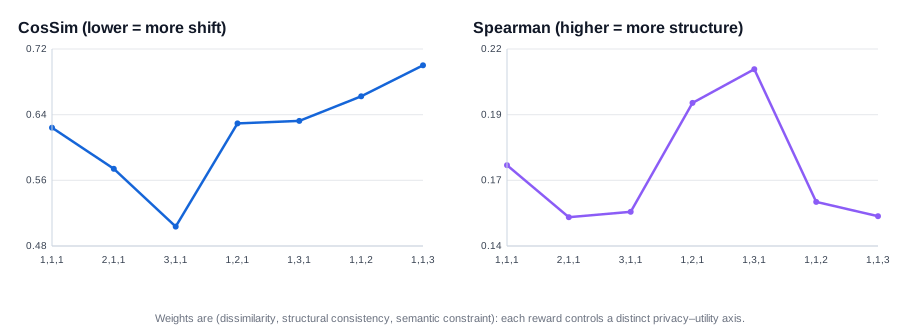
The three rewards control different axes: dissimilarity strengthens semantic displacement, structural consistency raises neighborhood preservation, and the semantic constraint keeps outputs on a valid semantic manifold. Over-weighting the constraint makes variants too close to the source.
The current implementation applies a unified obfuscation strategy rather than assigning stronger protection to especially sensitive or rare words. It also introduces extra LLM generation cost, and the current study focuses on textual side information. Sensitivity-aware privacy budgets, lightweight policy distillation, retrieval-based reuse, and multimodal relational fidelity are natural extensions.
git clone https://github.com/Shengxiang-Lin/PGPO.git
cd PGPO

conda create -n pgpo python=3.10 -y
conda activate pgpo
pip install -r requirements.txt@inproceedings{lin2026pgpo,
title={{PGPO}: Prototype-Guided Progressive Obfuscation for Privacy-Preserving LLM-Enhanced Recommendation},
author={Lin, Shengxiang and Su, Jiajie and Zhou, Pengyang and Chen, Xiang and Zheng, Xiaolin and Tian, Feng and Chen, Chaochao},
booktitle={Proceedings of the 2026 Conference on Empirical Methods in Natural Language Processing},
year={2026},
note={To appear}
}
This work was supported by the National Natural Science Foundation of China under Grant Nos. 72192823, 62177038, 62522217 and 624B2131.